
Investing in a condominium can be a powerful way to build wealth, but choosing where to invest is just as important as picking the right property. Two popular markets in the New York City area are Manhattan and Hoboken – each with its own price points, expenses, and lifestyle appeal. This article will compare condo investments in Hoboken (a vibrant New Jersey city just across the Hudson River) and Manhattan (the heart of New York City) from a return on investment (ROI) perspective. We’ll look at purchase prices, costs like HOA fees and taxes, rental income potential, and broader factors like commuting and appreciation trends. The goal is to give you a clear, accessible picture – in plain language – of how a Hoboken condo investment stacks up against one in Manhattan in 2025.
Both markets have strong demand and unique advantages. Manhattan condos are world-renowned and tend to have high property values and sky-high rents, whereas Hoboken offers a slightly more accessible entry price and a neighborhood feel while still commanding robust rents. By understanding the numbers and the lifestyle factors, you can make an informed decision about which market might better suit your investment goals. Let’s dive into the key metrics and considerations for condo ROI in Hoboken versus Manhattan.
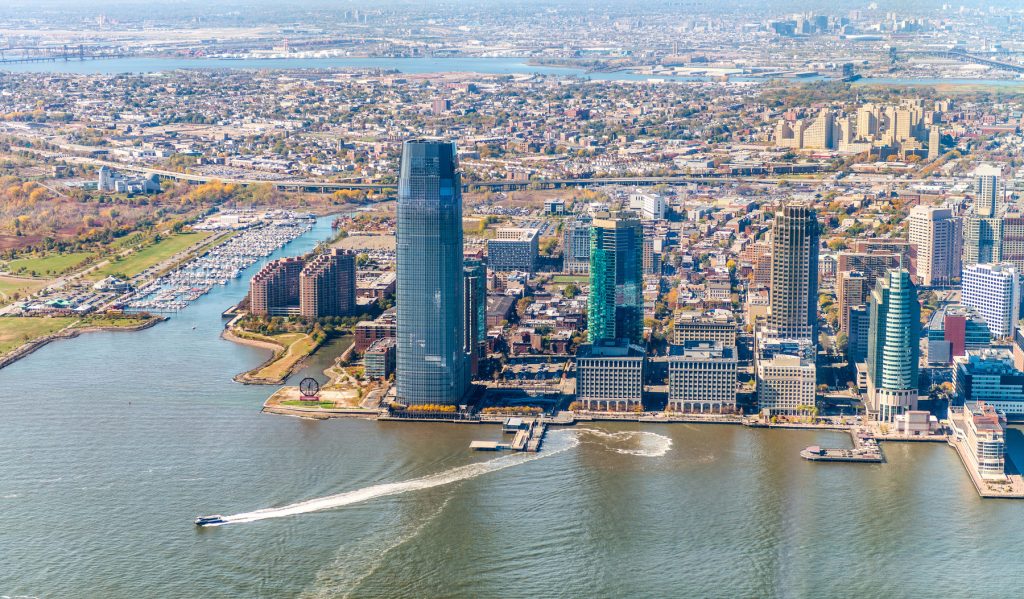
KEY METRICS: HOBOKEN VS. MANHATTAN CONDO INVESTMENT AT A GLANCE
To start, here’s a quick comparison of some key metrics for condo investments in Hoboken and Manhattan. These figures give a snapshot of typical costs and returns in 2025:
| Metric | Hoboken, NJ | Manhattan, NYC |
| Average Purchase Price | ~$800,000 (mid-range condo) | ~$1.7 million (median condo) |
| Average HOA Fees | ~$400–$700 per month (typical range) | Often $1,500+ per month (luxury high-rises even more) |
| Property Taxes | ~1.6% of value (≈$12k/year on a $750k home) | Lower effective rate (~0.8–1.2%); avg ~$15k/year for condos |
| Average Rent (monthly) | ~$3,900 (all-size avg.) | ~$4,500 (median; record high) |
| Estimated Rental Yield (Annual Rent ÷ Price) | ~5% (gross yield on typical condo) | ~3% (gross yield on typical condo) |
Table: Comparing typical condo investment metrics in Hoboken and Manhattan (2025). HOA = Homeowners Association fees. Rental yield is a basic estimate of annual rent relative to purchase price.
As the table shows, Manhattan condos are far more expensive on average (often double the price of a similar Hoboken unit), and they come with significantly higher monthly fees. Hoboken condos, while not cheap, have a lower price point and still command high rents, resulting in potentially higher rental yield percentages. However, these numbers are just the starting point. Next, we’ll break down what they mean in terms of upfront costs, ongoing expenses, and the practical realities of owning and renting out a condo in each location.
UPFRONT COSTS: PURCHASE PRICES AND INITIAL EXPENSES
One of the stark differences between Hoboken and Manhattan is the initial price of entry for a condo investment. In Hoboken, the median sale price of homes (mostly condos) was around $800,000 in mid-2025, depending on the source and exact location. You can find one-bedroom condos in Hoboken in the high six-figure range, and two-bedrooms typically in the $800K–$1M range. This is certainly a substantial investment, but it pales in comparison to Manhattan. In Manhattan, the median price for a condominium is about $1.7 million as of early 2025. Many Manhattan one-bedrooms easily top $1 million, and larger or luxury units can go for several million dollars.
What does this mean for an investor? Higher purchase price means a larger down payment and closing costs upfront. For example, a 20% down payment on an $800,000 Hoboken condo is $160,000, whereas 20% down on a $1.7 million Manhattan condo is $340,000 – more than double. Additionally, closing costs (such as transfer taxes, attorney fees, and title insurance) tend to be higher in New York City. NYC condos often incur city and state transfer taxes and mortgage recording taxes that New Jersey transactions don’t have at the same scale. In Hoboken (and NJ generally), you’ll have a realty transfer fee and other closing costs, but the overall upfront cash required is much lower simply because the purchase prices are lower.
It’s also worth noting that Manhattan has a mix of co-ops and condos, but here we’re focusing on condos (co-ops have different rules and typically lower prices but stricter buyer requirements). The high prices of Manhattan condos reflect their prestige and demand – investors from around the world target Manhattan, keeping prices very high. Hoboken’s market is competitive (with prices rising ~6–7% year-over-year recently), but it is more locally driven and tied to the NYC metro area workforce.
Bottom line: if your budget for purchase is under $1 million, you will find more options in Hoboken. In Manhattan, $1 million might only secure a small one-bedroom or studio condo in many neighborhoods. The initial cost difference is substantial, and it will influence not just your down payment but also your financing (bigger loans for Manhattan mean higher monthly mortgage payments) and potentially your ability to diversify investments.
ONGOING COSTS: HOA FEES, MAINTENANCE, AND PROPERTY TAXES
Buying the condo is just the beginning. To truly gauge ROI, you must factor in the ongoing costs of ownership – chiefly HOA fees (Homeowners Association fees, also called common charges or maintenance fees) and property taxes, and also insurance and upkeep.
HOA Fees: Every condo owner pays HOA or common charges to cover building operating costs, staff, amenities, and reserves for future repairs. These fees can vary widely. In Hoboken, many condo buildings have relatively moderate HOA fees, often in the range of a few hundred dollars per month for a mid-size building with minimal amenities. A typical Hoboken condo might have HOA fees around $400–$700 per month. Newer luxury buildings with doormen, gyms, or pools can be higher, but in general Hoboken’s HOA fees are relatively reasonable for the region.
In Manhattan, by contrast, HOA or common charges are famously high – especially in full-service buildings. It’s not uncommon to see monthly HOA fees exceed $1,000 or $2,000 for a Manhattan condo, and in ultra-luxury buildings they can be several thousand per month. According to market reports, the average monthly common charge (plus property tax) for Manhattan condos reached a record high of $4,802 in early 2025. This figure includes taxes, but it underscores how costly monthly charges can be in Manhattan. Even co-ops (which often have lower prices) had average maintenance of ~$2,974 monthly. Essentially, Manhattan condo owners often pay more each month in HOA dues than Hoboken owners pay for their mortgage. High HOA fees in Manhattan cover things like 24-hour doormen, concierge services, on-site gyms, elevators, and building staff – services that add convenience but eat into your rental yield.
Property Taxes: Here we see a somewhat counter-intuitive twist. New Jersey property taxes are well-known for being high. Hoboken’s property tax rate is about 1.6% of a property’s value (effective rate) on average. So, if you bought a Hoboken condo for around $800,000, you might pay roughly $12,000–$13,000 per year in property taxes (that’s $1,000+ per month). New York City, on the other hand, has a complex property tax system with different classes, but condos (classified as Class 2 properties) often have a lower effective property tax rate relative to market value – roughly in the 0.8%–1.2% range of the unit’s market value, depending on assessments and abatements. In fact, citywide data shows the average property tax bill for a condo unit in NYC is about $15,134 per year as of 2025. Considering many Manhattan condos are over $1 million, that effective tax rate can be under 1% in many cases (partly because NYC assesses condos based on comparable rental building incomes, not true market sales).
For an investor, this means Hoboken owners pay more in tax relative to their property’s value than Manhattan owners do. Your annual tax bill on a Hoboken condo could be similar to that of a Manhattan condo half again its price. This helps offset some of Manhattan’s expenses – NYC’s tax advantage is one reason some investors still like Manhattan despite lower yields, since property tax is a significant expense. That said, New York’s tax bills have been rising and hitting record highs as well, and future reforms could change the landscape. But as of 2025, Hoboken’s higher tax rate vs. Manhattan’s higher HOA fees is a trade-off to consider.
Aside from HOA and taxes, don’t forget other ongoing costs like insurance and maintenance. Condo owners need an insurance policy (generally cheaper than a standalone home’s insurance; often a few hundred dollars a year). Maintenance of the interior of the unit is your responsibility – things like appliances or repairs inside the apartment – but the HOA covers exterior and common area maintenance. In a new Manhattan high-rise, maintenance might be low initially (since building systems are new), whereas an older Hoboken brownstone condo might occasionally need special assessments (e.g., for a roof repair) if the reserve fund isn’t sufficient. Generally, factoring 1% of the property value per year for maintenance is a safe cushion, though condos can be less unpredictable than old houses.
Bottom line: Manhattan condos will cost significantly more each month to carry, primarily due to HOA fees. Hoboken condos have higher taxes proportionally, but the total monthly carrying cost (HOA + taxes) often still comes out lower than Manhattan’s. As an example, an average Hoboken condo might incur ~$1,500/month between HOA and taxes, whereas a Manhattan condo might be $3,000–$4,000/month for those expenses. These ongoing costs directly affect your net ROI (they eat into rental income), so they’re critical to weigh.

APPRECIATION TRENDS AND LONG-TERM VALUE
ROI isn’t only about the rent checks; it’s also about how the property’s value grows over time (appreciation). This is where Manhattan has historically shined, though Hoboken has a good story to tell as well.
Manhattan Appreciation: Over the long run, Manhattan real estate has proven to be a very resilient and appreciating asset. In fact, over the 25-year period from 1999 to 2025, Manhattan condos have averaged about 6% annual appreciation in price. There have been ups and downs – Manhattan saw a slowdown and slight dips around 2017–2019 due to tax law changes and oversupply in luxury units, and a sharp but brief drop during the 2020 pandemic. But it often bounces back quickly. By Q1 2025, Manhattan prices were rising again: the median sales price for Manhattan co-ops and condos jumped 11% year-over-year to $1.165 million (combined) in that quarter, showing a strong post-pandemic normalization. For condos specifically, the median was around $1.725M, up ~5.7% YoY. Manhattan is such a global market that, over time, demand has continually pushed prices upward, barring short corrections.
Investors view Manhattan property almost like a blue-chip stock – it’s not likely to double in a year, but over a decade or two it tends to gain significant value. Neighborhoods can gentrify and appreciate, and even established areas just get pricier as land is finite. For example, new development condos in Manhattan are selling at record prices (the average new development condo was ~$3.95M in early 2025, up 21% YoY), indicating confidence in future values. The trade war and stock market volatility in 2025 did introduce some uncertainty, but as one expert noted, Manhattan’s market in 2025 is about “getting back to normal” after a turbulent few years – basically, a stable growth path rather than a bubble or crash scenario.
Hoboken Appreciation: Hoboken’s trajectory tends to align with the health of the New York City metro area. It had a tremendous boom in the early 2000s and again in the 2010s as more people discovered that they could live a 15-minute train ride from Manhattan in a charming, smaller city. Hoboken property values have generally risen, though perhaps not as meteoric in percentage as some Brooklyn neighborhoods. According to Redfin, Hoboken home prices were up about 6.9% year-over-year in May 2025, showing solid growth. The median price (~$895K) is approaching that of some NYC boroughs like Brooklyn, which speaks to Hoboken’s desirability. During the pandemic, Hoboken (like many suburbs and “near-urbs”) saw increased interest as some city dwellers looked for a bit more space; this likely buoyed values as well.
Over a longer horizon, Hoboken has appreciated well, but it can be more volatile in downturns. For instance, Hoboken saw price softening in the late 2000s recession and again slight dips if NYC’s economy struggles. It doesn’t have the same global investor base as Manhattan; its buyers are often local or regional. That said, Hoboken’s limited size (just one square mile city) and high demand keep supply tight, which supports values. New developments in Hoboken (e.g., luxury high-rises on the waterfront) have pushed price per square foot up, and older condo units in brownstones have also steadily increased in value due to scarcity.
Looking ahead, both markets have reasons for optimism. Manhattan is benefiting from people returning to the city, high rents converting some renters to buyers, and a strong job market in NYC’s finance and tech sectors in 2025. Hoboken is benefiting from being a relatively affordable alternative to Manhattan and Brooklyn while offering a high quality of life and easy commute. Lifestyle trends also matter: if more companies allow hybrid work, some might choose Hoboken to have a home office and a bit more space, while still coming into Manhattan as needed. Conversely, if everyone is back in the office daily, the draw of living right in Manhattan might increase.
One more angle: exit strategy. If you plan to hold the condo long-term, appreciation is key. Manhattan’s long-term track record is very strong – it’s rare to meet someone who bought a Manhattan condo and lost money a decade later. Hoboken also has a good track record, but if an investor needed to sell in a soft market, Manhattan’s global demand might provide more liquidity (there’s almost always a buyer for a well-priced Manhattan condo). Hoboken’s buyer pool is smaller, which could mean slightly longer times to sell or more sensitivity to interest rates. As of mid-2025, both markets are described as somewhat competitive seller’s markets (Hoboken homes selling in ~23 days on average, Manhattan inventory still relatively tight by historical standards).
Bottom line: Manhattan likely offers more predictable long-term appreciation, while Hoboken offers good appreciation with a bit more local market dependency. If your investment horizon is many years or decades, Manhattan’s ROI might materialize more in the form of price growth, whereas Hoboken gives you more ROI in the form of ongoing rental income plus steady growth. Ideally, an investor wants both increasing value and strong income – your choice might depend on which aspect (income vs. growth) you prioritize.

LIFESTYLE AND COMMUTING FACTORS: BEYOND THE NUMBERS
ROI isn’t just a spreadsheet figure; it can also be influenced by lifestyle factors because those drive demand (and thus rent and resale value). Even if you’re investing purely for rental, you should consider what type of renters you’ll attract and what might make the property more or less desirable in the long run.
Location & Lifestyle in Manhattan: Owning a condo in Manhattan means owning a piece of one of the world’s most iconic urban centers. The lifestyle for residents is fast-paced and convenience-oriented: you (or your tenant) walk out the door to shops, restaurants, museums, Central Park (depending on neighborhood), Broadway shows – essentially, the best of city living. There’s also the convenience of being close to work if the job is in Manhattan – no bridges or tunnels to contend with. From a value perspective, certain Manhattan neighborhoods carry cachet (think Tribeca, Upper West Side, SoHo) which can help with both rent and resale. However, city living also means higher day-to-day costs (groceries, parking, etc.) and usually less space for the money. Many Manhattan condos, especially at entry level, are relatively small (studios or compact 1-bedrooms). That can affect renter profiles – often single professionals or couples without kids are your target tenants, rather than families.
For an investor who may plan to use the condo themselves occasionally, Manhattan offers the ultimate pied-à-terre appeal. But keep in mind, New York has restrictions on using apartments as short-term rentals (Airbnb) – so your ROI should plan on a traditional 12-month lease model in most cases, not vacation rentals.
Location & Lifestyle in Hoboken: Hoboken offers a blend of city and neighborhood charm. It’s often described as having a “small-town feel with big-city access.” Residents enjoy a lively restaurant and bar scene (Washington Street is the main drag with cafes, boutiques, nightlife), community events, and waterfront parks with stunning views of the Manhattan skyline. It’s a very walkable city, and many New Yorkers actually come to Hoboken for its dining and festivals. Hoboken is also known for a strong sense of community – something that might keep renters around longer. It’s not uncommon for renters to fall in love with Hoboken and eventually become buyers there.
Crucially, Hoboken is a commuter’s haven. It’s just across the Hudson River from Manhattan – you can be at Midtown or downtown offices in 10–20 minutes via PATH trains or ferries. Trains run frequently and late into the night, making it feasible for young professionals to live in Hoboken while working (and socializing) in Manhattan. This proximity is a selling point both for renters and future buyers. Compared to living in outer boroughs of NYC that might require a long subway ride, Hoboken can be just as convenient, if not more so for certain locations. For example, the PATH from Hoboken to the Wall Street area is around 10–15 minutes.
From a lifestyle ROI perspective: if trends ever shift and people put more premium on space, Hoboken might gain relative value because you generally get a bit larger unit (maybe a second bedroom or a balcony) for much less cost than Manhattan. Hoboken also has a mix of modern high-rises and historic brownstone condos, appealing to a broad range of tastes. Families are more likely to live in Hoboken condos than in tiny Manhattan condos, so your rental pool could include young families (Hoboken has good schools for early childhood and plenty of playgrounds, which attract that demographic).
One must mention parking – in Manhattan, a parking spot is a luxury (and can cost hundreds per month separately). In Hoboken, while street parking can be competitive, many newer condos come with a parking garage or spot. Having parking included can boost your rentability in Hoboken for those who have cars. It’s another lifestyle consideration.
Lastly, consider quality of life vs. prestige. Some renters/buyers will pay more to have a Manhattan address (prestige, zero commute, the “center of the universe” feeling). Others value the relative tranquility of Hoboken – less noise, maybe a bit more green space, and a community vibe – and they’re willing to pay high rents there too. Neither choice is “right” for everyone, but as an investor, aligning your purchase with market preferences is key. In 2025, there’s healthy demand for both: people are moving back to Manhattan for convenience and people are moving to Hoboken for a bit more space, keeping both markets hot.
Bottom line: In terms of long-term ROI, the lifestyle factors influence who will rent your property and how much they’ll pay. Manhattan will attract a larger pool of high-paying tenants but likely more churn; Hoboken might attract slightly more cost-conscious (but still well-paid) tenants who could stay longer. Both areas benefit from proximity to high-paying jobs – one by being in the thick of it, the other by a short commute. Your personal preference might also come into play if you intend to live in or frequently visit your investment: some investors choose Hoboken because they themselves prefer a quieter home base with an easy hop to the city, whereas others want to be in Manhattan’s energy 24/7. In either case, the desirability of the location supports the investment’s value.
CHOOSING THE RIGHT CONDO INVESTMENT FOR YOUR GOALS
Both Hoboken and Manhattan present compelling investment opportunities, but in different ways. To summarize the ROI perspective: Hoboken condos generally offer a lower cost of entry and better cash flow (higher rental yield), while Manhattan condos offer unparalleled location, prestige, and historically strong appreciation potential.
If you are an investor looking for steady rental income and a more affordable path into the market, a Hoboken condo might be the better fit. Your dollars buy more space in Hoboken, your percentage return on rent can be higher, and you’ll attract renters thanks to the city’s commute convenience and charm. The ongoing costs like HOAs are manageable, though keep an eye on those NJ property taxes. Hoboken’s market is thriving, and it provides a nice balance of urban living with a neighborhood feel – factors that should keep demand (and thus rents and values) strong in the long run.
On the other hand, if your priority is long-term capital appreciation and owning a piece of New York City itself, Manhattan is tough to beat. A Manhattan condo is a kind of trophy asset that historically grows in value and can offer tremendous intangible benefits. You might accept a slimmer annual ROI (even near break-even on rental income) knowing that the property could appreciate significantly over a decade. The rental demand in Manhattan is virtually guaranteed – there’s always someone looking to rent, especially as the city’s population and job base rebound. Just be prepared for the heavier carrying costs and the big upfront investment. Manhattan condos work well for investors who have the financial cushion to sustain the costs and are playing the “long game.”